Work & Study in Germany
Request a Free Consultation
What is Ausbildung in Germany?
Germany’s Dual Vocational Training system, known as "Ausbildung", is a unique educational model that combines classroom theory with real-world work experience. Unlike a standard degree, this program allows you to become a certified professional while earning a monthly salary.
Participants typically spend 50% of their time in a vocational school (Berufsschule) and 50% working at a German company. The company not only trains you but also pays for your tuition and provides a monthly stipend.
Why Choose Ausbildung?-
Financial Independence:
You don't need to rely on parents or loans. You earn a monthly gross wage (typically €800 - €1,500) from day one, which covers your living expenses.
-
Guaranteed Job Opportunities:
With Germany facing a shortage of skilled workers, companies invest in trainees to hire them permanently. Your chances of securing a full-time job immediately after graduation are incredibly high, with starting salaries often ranging from €2,400 to €3,500 per month.
-
Theory Meets Practice:
You won't just learn from books. You will gain hands-on experience in German industries, making you a highly competent professional in the global market.
-
Pathway to PR:
After completing your training, you are qualified to work as a skilled professional. This opens a direct path to permanent residency (PR) in Germany.
Eligibility Criteria
Who can apply? Any foreign national can apply, provided they meet the basic requirements:
- Age Limit: Typically between 18 and 30 years old (exceptions exist for Nursing).
- Education: Higher Secondary Certificate (12th Grade) or Diploma.
- Language: German Language Proficiency Level B1 or B2 (Mandatory).
Popular Ausbildung Professions
Top Career Pathways
Nursing (Pflegefachmann/frau)
One of the most in-demand fields in Germany. You will learn patient care, medical procedures, and documentation. Nursing offers high stipends and excellent job security in hospitals and care homes.
IT Specialist
Become an expert in system integration or application development. You will work on real IT projects, coding, and hardware management while attending tech classes.
Hospitality (Hotelfachmann/frau)
Train in Germany’s robust tourism industry. You will rotate through various departments like reception, service, and housekeeping, learning how to manage top-tier hotel operations.
Mechatronics
Perfect for those who love engineering. This course combines mechanics and electronics. You will learn to build, maintain, and repair complex machinery in Germany's famous automotive and manufacturing sectors.
Roadmap
Your Journey to Germany
How to go from an applicant to an apprentice in 4 steps:
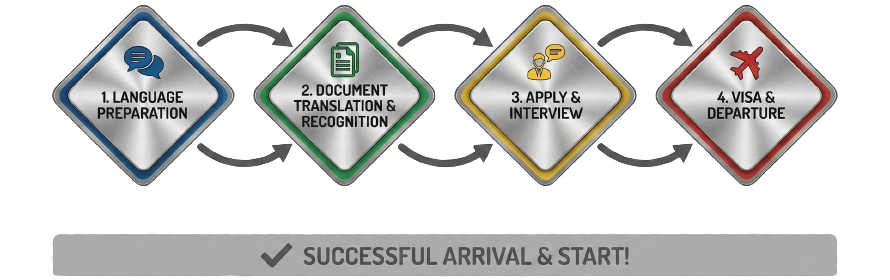
Language Preparation
The key to Ausbildung is German language skills. You must complete up to Level B1 or B2. We help you achieve the required proficiency through intensive language training.
Document Translation & Recognition
Your 12th-grade marksheet and other certificates must be translated into German and legally recognized (Anerkennung) by German authorities to ensure they meet local standards.
Apply & Interview
We assist in creating a German-standard CV and motivation letter. You will apply to companies and attend online interviews. Once successful, you receive a Training Contract.
Visa & Departure
With your contract and language certificate, you apply for the Vocational Training Visa. Upon approval, you fly to Germany, register at the city office, and start your new life!
FAQs
Generally, no. Since you receive a monthly salary (stipend) from the employer that covers your living costs, a blocked account is usually not required for the visa, unlike standard student visas.
The average gross monthly wage is between €800 and €1,500. This amount increases with each year of training. After completing the course, starting salaries can range from €2,400 to €3,500.
Yes! German companies invest in training you because they want to hire you. After passing your final exams, you can be hired as a full-time skilled worker, which allows you to apply for permanent residency.
Since the theoretical classes and workplace communication happen in German, you must have a B1 or preferably B2 level certification (Goethe/Telc) to apply successfully.